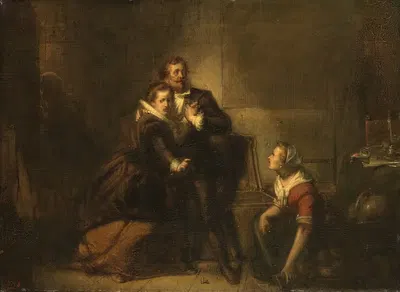
The Italian Beauty (1875)
Wolfgang BoehmFor your project
- Source and licence confirmed before use
- Print-ready master at your wall size
- Adapted to your format and palette on request
Provenance / Rights
- Rights
- Public domain (artist died 1890)
SPECIFICATIONS
- Artist
- Wolfgang Boehm
- Category
- Figurative
- Year
- 1875
- Nationality / school
- Austrian
- Lifespan
- 1823–1890
- Orientation
- Portrait
- Material
- Digital JPEG + PDF files
- Available sizes
- Print-ready master at your wall size, on request
ABOUT THE ARTWORK
This page presents "The Italian Beauty" (1875), created by Wolfgang Boehm. Figurative, a short history: Portraits, group scenes, studies of the nude, and pictures of daily life all belong to figurative art. Over the centuries, painters have used the figure to express social standing, narrative, and emotion. About the period around 1875: The later nineteenth century is the era of Impressionism, whose first group exhibition was held in Paris in 1874, followed by Post-Impressionism, Symbolism, and the Arts and Crafts movement. In the 1890s, colour lithography and Art Nouveau made the illustrated poster a celebrated art form. It is listed in the Figurative collection. The image is in portrait orientation.
"The Italian Beauty" is offered as a printable file (Digital JPEG + PDF files, 300 DPI) rather than a shipped item. You receive the files by email after payment and handle printing yourself, which gives you full control over paper, size, and finish. A portrait format suits narrow wall spaces, hallways, and the area beside a door or window. Figurative works draw attention to the human presence, the gesture, and the emotional tone, so they work particularly well as a standalone focal point in living rooms, studies, and bedrooms. Measuring the wall before choosing a size is the simplest way to avoid a print that feels too small or too large. Matte and fine-art papers reduce glare in bright rooms, while glossy papers give stronger contrast and deeper blacks. Hang the print away from direct sunlight, which over the years can fade any printed colour. Screens and printers render colour differently, so a small test print is a sensible way to check tones before committing to a large size.
ABOUT THE ARTIST
Austrian, 1823–1890
If you like the visual language of Wolfgang Boehm, explore more works by the same artist in our collection.