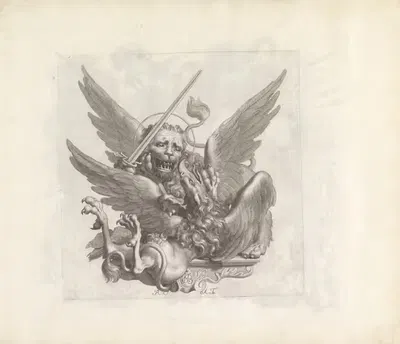
The End of Ramazan (1883-1884)
Elihu VedderFor your project
- Source and licence confirmed before use
- Print-ready master at your wall size
- Adapted to your format and palette on request
Provenance / Rights
- Rights
- Public domain (artist died 1923)
SPECIFICATIONS
- Artist
- Elihu Vedder
- Category
- Illustration
- Year
- 1883-1884
- Nationality / school
- American
- Lifespan
- 1836–1923
- Orientation
- Portrait
- Material
- Digital JPEG + PDF files
- Available sizes
- Print-ready master at your wall size, on request
HELPFUL LINKS
ABOUT THE ARTWORK
Dated 1883-1884, "The End of Ramazan" is an artwork by Elihu Vedder. Historical background, 1883-1884: The later nineteenth century is the era of Impressionism, whose first group exhibition was held in Paris in 1874, followed by Post-Impressionism, Symbolism, and the Arts and Crafts movement. Japanese prints reached Europe in large numbers and influenced many artists, while photography changed what painting needed to do. Illustration in brief: The late nineteenth and early twentieth centuries are often described as a golden age of book and magazine illustration. Illustration serves a text or a story, a tradition that runs from decorated medieval manuscripts to printed book plates, magazines, and posters. The catalogue places it in Illustration. The format is portrait.
Everything for "The End of Ramazan" arrives digitally: Digital JPEG + PDF files, 300 DPI. Once payment is confirmed, an email brings the download link, and from there you decide how to print it, whether at home, at a print shop, or through an online service. A portrait format suits narrow wall spaces, hallways, and the area beside a door or window. Illustrative graphics are valued for their decorative line work and narrative quality, which makes them a strong fit for gallery walls, kids rooms, studies, and more intimate interiors. Matching the frame to the image proportions avoids cropping. Choosing a standard frame size and printing to fit it often saves the cost of custom framing. Matte and fine-art papers reduce glare in bright rooms, while glossy papers give stronger contrast and deeper blacks. Hang the print away from direct sunlight, which over the years can fade any printed colour.
ABOUT THE ARTIST
American, 1836–1923
If you like the visual language of Elihu Vedder, explore more works by the same artist in our collection.