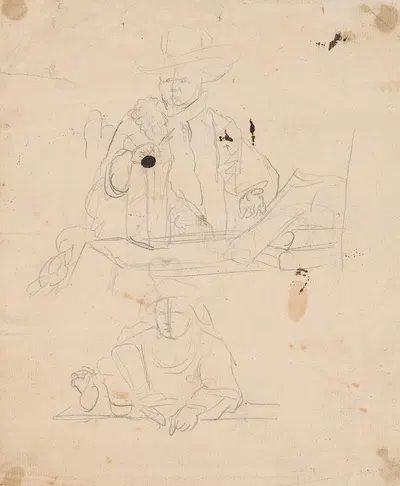
The Baroness Duperré and Her Daughters (1841)
Théodore ChassériauFor your project
- Source and licence confirmed before use
- Print-ready master at your wall size
- Adapted to your format and palette on request
Provenance / Rights
- Rights
- Public domain (artist died 1856)
SPECIFICATIONS
- Artist
- Théodore Chassériau
- Category
- Drawings
- Year
- 1841
- Nationality / school
- French
- Lifespan
- 1819–1856
- Orientation
- Portrait
- Material
- Digital JPEG + PDF files
- Available sizes
- Print-ready master at your wall size, on request
HELPFUL LINKS
ABOUT THE ARTWORK
Dated 1841, "The Baroness Duperré and Her Daughters" is an artwork by Théodore Chassériau. Historical background, 1841: Landscape gained new prestige through groups such as the Barbizon painters in France and the Hudson River School in the United States, and by mid-century Realism turned to ordinary people and everyday labour. The invention of lithography around 1796 and its spread in these decades made printed images cheaper and more varied. The catalogue places it in Drawings. The format is portrait. Drawings in brief: Drawings range from quick preparatory sketches to finished works in pen, chalk, charcoal, graphite, or wash. Because line carries so much of the effect, drawings tend to reward close looking at the quality of the mark.
On onlly.art "The Baroness Duperré and Her Daughters" is sold as a digital download (Digital JPEG + PDF files, 300 DPI). The files are delivered by email after payment, so nothing is shipped: you print locally, choosing the paper, size, and frame yourself. A portrait format suits narrow wall spaces, hallways, and the area beside a door or window. Before printing, compare the proportions of the file with your frame so that nothing important is cropped. Choosing a standard frame size and printing to fit it often saves the cost of custom framing. Screens and printers render colour differently, so a small test print is a sensible way to check tones before committing to a large size. Matte and fine-art papers reduce glare in bright rooms, while glossy papers give stronger contrast and deeper blacks.
ABOUT THE ARTIST
French, 1819–1856
If you like the visual language of Théodore Chassériau, explore more works by the same artist in our collection.