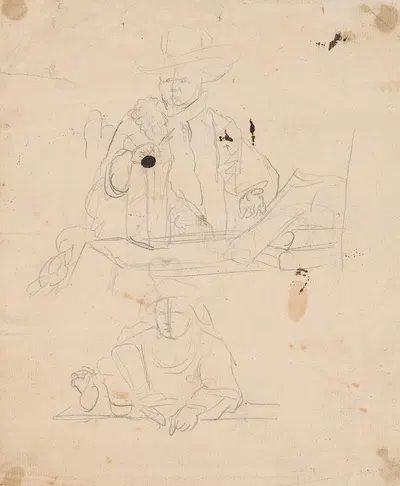

Self-Portrait Leaning on a Stone Sill (1639)
Rembrandt van RijnFor your project
- Source and licence confirmed before use
- Print-ready master at your wall size
- Adapted to your format and palette on request
Provenance / Rights
- Rights
- Public domain (artist died 1669)
SPECIFICATIONS
- Artist
- Rembrandt van Rijn
- Category
- Drawings
- Year
- 1639
- Nationality / school
- Dutch
- Lifespan
- 1606–1669
- Orientation
- Portrait
- Material
- Digital JPEG + PDF files
- Available sizes
- Print-ready master at your wall size, on request
HELPFUL LINKS
ABOUT THE ARTWORK
This page presents "Self-Portrait Leaning on a Stone Sill" (1639), created by Rembrandt van Rijn. Context for 1639: In the Dutch Republic, a prosperous middle-class market supported landscapes, still lifes, portraits, and scenes of daily life painted at a modest scale for the home. The seventeenth century is the age of the Baroque, which favoured dramatic light, movement, and strong emotion in the work of painters in Italy, Spain, and Flanders. Drawings in brief: Because line carries so much of the effect, drawings tend to reward close looking at the quality of the mark. Drawings range from quick preparatory sketches to finished works in pen, chalk, charcoal, graphite, or wash. The catalogue places it in Drawings. The format is portrait.
"Self-Portrait Leaning on a Stone Sill" is offered as a printable file (Digital JPEG + PDF files, 300 DPI) rather than a shipped item. You receive the files by email after payment and handle printing yourself, which gives you full control over paper, size, and finish. A portrait format suits narrow wall spaces, hallways, and the area beside a door or window. Drawings and sketches stand out through line clarity and a sense of the artist process, which makes them a natural fit for minimalist, monochrome, and graphic interiors. Measuring the wall before choosing a size is the simplest way to avoid a print that feels too small or too large. Matte and fine-art papers reduce glare in bright rooms, while glossy papers give stronger contrast and deeper blacks. Hang the print away from direct sunlight, which over the years can fade any printed colour. Screens and printers render colour differently, so a small test print is a sensible way to check tones before committing to a large size.
ABOUT THE ARTIST
Dutch, 1606–1669
If you like the visual language of Rembrandt van Rijn, explore more works by the same artist in our collection.