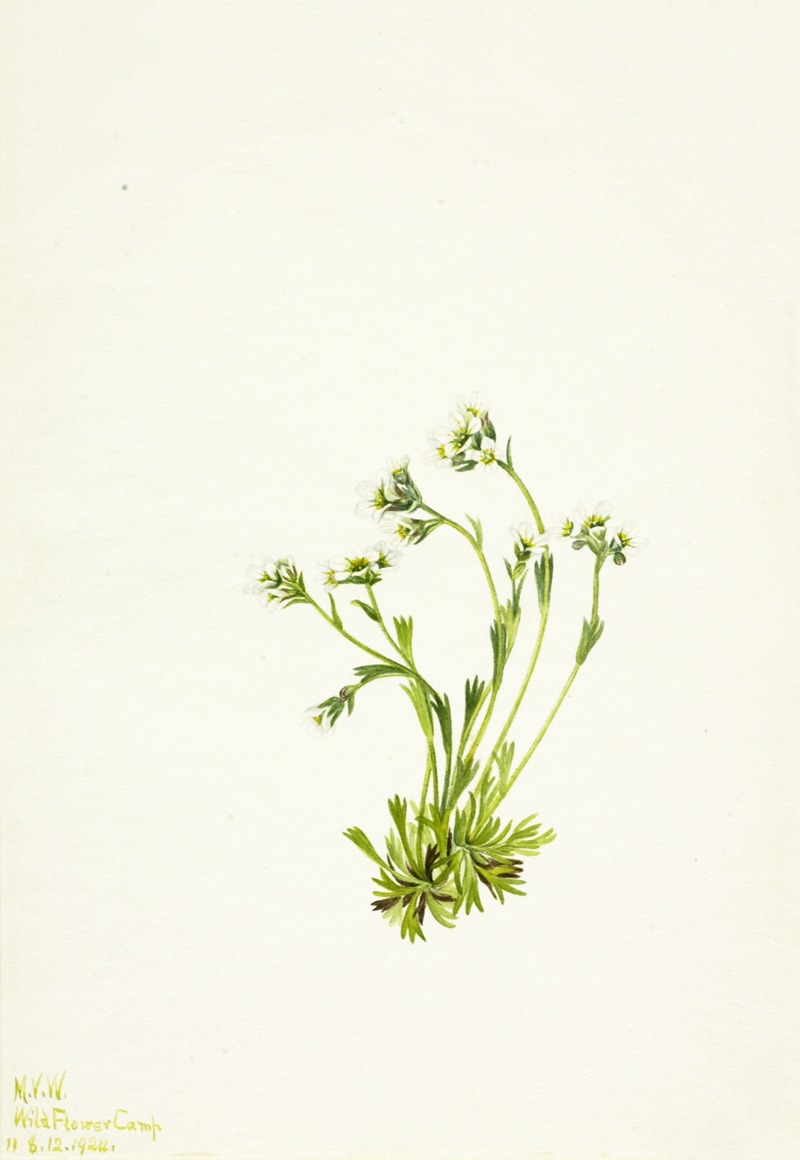
Saxifrage (Saxifraga caespitosa) (1924)
Mary Vaux WalcottFor your project
- Source and licence confirmed before use
- Print-ready master at your wall size
- Adapted to your format and palette on request
Provenance / Rights
- Rights
- Public domain (artist died 1940)
SPECIFICATIONS
- Artist
- Mary Vaux Walcott
- Category
- Plants & Animals
- Year
- 1924
- Nationality / school
- American
- Lifespan
- 1860–1940
- Orientation
- Portrait
- Material
- Digital JPEG + PDF files
- Available sizes
- Print-ready master at your wall size, on request
ABOUT THE ARTWORK
Dated 1924, "Saxifrage (Saxifraga caespitosa)" is an artwork by Mary Vaux Walcott. Plants & Animals, a short history: Naturalists and artists often worked together, especially on voyages and in published surveys of flora and fauna. Images of plants and animals run from medieval herbals and bestiaries to the scientific illustration of the seventeenth to nineteenth centuries. About the period around 1924: Dada and Surrealism followed the First World War, the Bauhaus school was founded in 1919, and Art Deco became the fashionable decorative style of the 1920s and 1930s. The first decades of the twentieth century were a period of rapid experiment, with Fauvism, Expressionism, Cubism, Futurism, and the first abstract painting appearing within a few years of each other. It is listed in the Plants & Animals collection. The image is in portrait orientation.
On onlly.art "Saxifrage (Saxifraga caespitosa)" is sold as a digital download (Digital JPEG + PDF files, 300 DPI). The files are delivered by email after payment, so nothing is shipped: you print locally, choosing the paper, size, and frame yourself. A portrait format suits narrow wall spaces, hallways, and the area beside a door or window. Flora and fauna subjects make an interior feel softer and more alive, adding a natural rhythm that works well in both traditional and contemporary spaces. Before printing, compare the proportions of the file with your frame so that nothing important is cropped. Hang the print away from direct sunlight, which over the years can fade any printed colour. Choosing a standard frame size and printing to fit it often saves the cost of custom framing. Screens and printers render colour differently, so a small test print is a sensible way to check tones before committing to a large size.
ABOUT THE ARTIST
American, 1860–1940
If you like the visual language of Mary Vaux Walcott, explore more works by the same artist in our collection.


