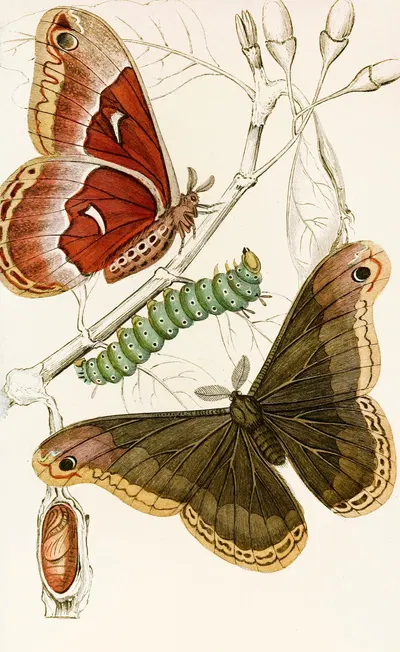
Saturnia Maia, Aglia Io (1833)
James DuncanFor your project
- Source and licence confirmed before use
- Print-ready master at your wall size
- Adapted to your format and palette on request
Provenance / Rights
- Rights
- Public domain (artist died 1881)
SPECIFICATIONS
- Artist
- James Duncan
- Category
- Plants & Animals
- Year
- 1833
- Nationality / school
- Canadian
- Lifespan
- 1806–1881
- Orientation
- Portrait
- Material
- Digital JPEG + PDF files
- Available sizes
- Print-ready master at your wall size, on request
ABOUT THE ARTWORK
This page presents "Saturnia Maia, Aglia Io" (1833), created by James Duncan. Context for 1833: The first half of the nineteenth century moved from Neoclassicism to Romanticism, which placed emotion, nature, and the sublime at the centre of painting. Landscape gained new prestige through groups such as the Barbizon painters in France and the Hudson River School in the United States, and by mid-century Realism turned to ordinary people and everyday labour. The catalogue places it in Plants & Animals. The format is portrait. Plants & Animals, a short history: Images of plants and animals are valued both for the care of their observation and for their decorative appeal. Images of plants and animals run from medieval herbals and bestiaries to the scientific illustration of the seventeenth to nineteenth centuries.
Your purchase of "Saturnia Maia, Aglia Io" on onlly.art is a digital download: Digital JPEG + PDF files, 300 DPI. After payment the download link arrives by email, and you can send the files to any print service you trust. A portrait format suits narrow wall spaces, hallways, and the area beside a door or window. Flora and fauna subjects make an interior feel softer and more alive, adding a natural rhythm that works well in both traditional and contemporary spaces. If you are unsure about size, measure the wall first, then pick a frame whose proportions follow the image. Choosing a standard frame size and printing to fit it often saves the cost of custom framing. Screens and printers render colour differently, so a small test print is a sensible way to check tones before committing to a large size. Matte and fine-art papers reduce glare in bright rooms, while glossy papers give stronger contrast and deeper blacks.
ABOUT THE ARTIST
Canadian, 1806–1881
If you like the visual language of James Duncan, explore more works by the same artist in our collection.