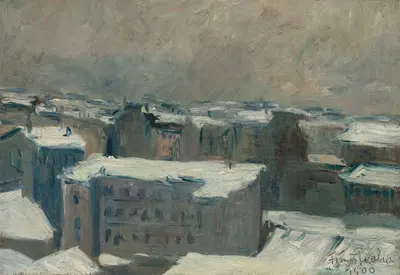
Danseuse étoile sur un transatlantique (1913)
Francis PicabiaFor your project
- Source and licence confirmed before use
- Print-ready master at your wall size
- Adapted to your format and palette on request
Provenance / Rights
- Rights
- Public domain (artist died 1953)
SPECIFICATIONS
- Artist
- Francis Picabia
- Category
- Abstract
- Year
- 1913
- Nationality / school
- French
- Lifespan
- 1879–1953
- Orientation
- Portrait
- Material
- Digital JPEG + PDF files
- Available sizes
- Print-ready master at your wall size, on request
ABOUT THE ARTWORK
This page presents "Danseuse étoile sur un transatlantique" (1913), created by Francis Picabia. Abstract, a short history: It emerged in the early twentieth century, when several artists in Europe and Russia developed non-representational painting during the 1910s. Movements of later decades, including Abstract Expressionism and geometric abstraction, carried non-representational ideas into new scales and materials. Context for 1913: Posters, magazines, and illustrated books were major ways for the public to meet new art and design. The first decades of the twentieth century were a period of rapid experiment, with Fauvism, Expressionism, Cubism, Futurism, and the first abstract painting appearing within a few years of each other. It is listed in the Abstract collection. The image is in portrait orientation.
"Danseuse étoile sur un transatlantique" is offered as a printable file (Digital JPEG + PDF files, 300 DPI) rather than a shipped item. You receive the files by email after payment and handle printing yourself, which gives you full control over paper, size, and finish. A portrait format suits narrow wall spaces, hallways, and the area beside a door or window. Abstract compositions work through rhythm, colour, and form, which makes them especially effective in modern interiors and in spaces that need a strong visual accent without a literal narrative. Measuring the wall before choosing a size is the simplest way to avoid a print that feels too small or too large. Matte and fine-art papers reduce glare in bright rooms, while glossy papers give stronger contrast and deeper blacks. Hang the print away from direct sunlight, which over the years can fade any printed colour. Screens and printers render colour differently, so a small test print is a sensible way to check tones before committing to a large size.
ABOUT THE ARTIST
French, 1879–1953
If you like the visual language of Francis Picabia, explore more works by the same artist in our collection.