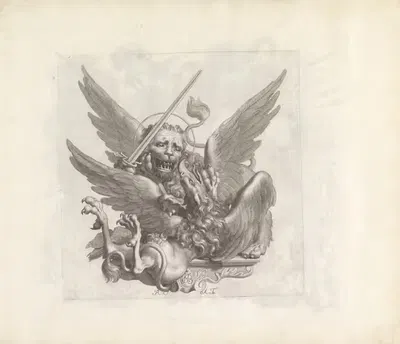
Trophies of War (1599)
Andrea MantegnaFor your project
- Source and licence confirmed before use
- Print-ready master at your wall size
- Adapted to your format and palette on request
Provenance / Rights
- Rights
- Public domain (artist died 1506)
SPECIFICATIONS
- Artist
- Andrea Mantegna
- Category
- Illustration
- Year
- 1599
- Nationality / school
- Italian
- Lifespan
- 1431–1506
- Orientation
- Square
- Material
- Digital JPEG + PDF files
- Available sizes
- Print-ready master at your wall size, on request
HELPFUL LINKS
ABOUT THE ARTWORK
Andrea Mantegna is the artist behind "Trophies of War", dated 1599. Background on Illustration: Printing methods such as woodcut, engraving, lithography, and photomechanical reproduction each shaped how illustrators worked. Illustration serves a text or a story, a tradition that runs from decorated medieval manuscripts to printed book plates, magazines, and posters. Context for 1599: The sixteenth century includes the High Renaissance in Italy, the Mannerist generation that followed it, and the Northern Renaissance of artists such as Dürer, Holbein, and Bruegel. Elsewhere, the Mughal court in India developed a distinctive tradition of miniature painting, and printed images continued to travel widely between countries. The catalogue places it in Illustration. The format is square.
Everything for "Trophies of War" arrives digitally: Digital JPEG + PDF files, 300 DPI. Once payment is confirmed, an email brings the download link, and from there you decide how to print it, whether at home, at a print shop, or through an online service. A square format is flexible and works well on its own or as part of a grid on a gallery wall. Matching the frame to the image proportions avoids cropping. Choosing a standard frame size and printing to fit it often saves the cost of custom framing. Screens and printers render colour differently, so a small test print is a sensible way to check tones before committing to a large size. Matte and fine-art papers reduce glare in bright rooms, while glossy papers give stronger contrast and deeper blacks.
ABOUT THE ARTIST
Italian, 1431–1506
If you like the visual language of Andrea Mantegna, explore more works by the same artist in our collection.