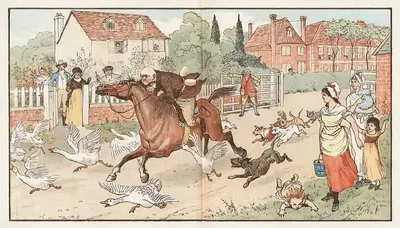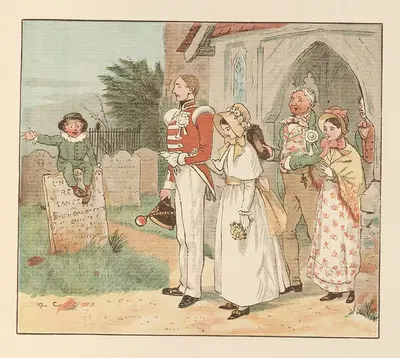

Sing a song for Sixpence Pl.5 (1887)
Randolph CaldecottFor your project
- Source and licence confirmed before use
- Print-ready master at your wall size
- Adapted to your format and palette on request
Provenance / Rights
- Rights
- Public domain (artist died 1886)
SPECIFICATIONS
- Artist
- Randolph Caldecott
- Category
- Illustration
- Year
- 1887
- Nationality / school
- English
- Lifespan
- 1846–1886
- Orientation
- Portrait
- Material
- Digital JPEG + PDF files
- Available sizes
- Print-ready master at your wall size, on request
HELPFUL LINKS
ABOUT THE ARTWORK
This page presents "Sing a song for Sixpence Pl.5" (1887), created by Randolph Caldecott. Historical background, 1887: The later nineteenth century is the era of Impressionism, whose first group exhibition was held in Paris in 1874, followed by Post-Impressionism, Symbolism, and the Arts and Crafts movement. In the 1890s, colour lithography and Art Nouveau made the illustrated poster a celebrated art form. It is listed in the Illustration collection. The image is in portrait orientation. Illustration, a short history: The late nineteenth and early twentieth centuries are often described as a golden age of book and magazine illustration. Illustration serves a text or a story, a tradition that runs from decorated medieval manuscripts to printed book plates, magazines, and posters.
Buying "Sing a song for Sixpence Pl.5" means getting a digital file, not a physical print: Digital JPEG + PDF files, 300 DPI, delivered by email once payment is confirmed. A 300 DPI file is intended for printing at home or at a local print shop, where you can choose a matte, satin, or fine-art paper to suit the room. A portrait format suits narrow wall spaces, hallways, and the area beside a door or window. Illustrative graphics are valued for their decorative line work and narrative quality, which makes them a strong fit for gallery walls, kids rooms, studies, and more intimate interiors. A simple frame with a mat often helps an image settle comfortably into a room. Matte and fine-art papers reduce glare in bright rooms, while glossy papers give stronger contrast and deeper blacks. Choosing a standard frame size and printing to fit it often saves the cost of custom framing. Screens and printers render colour differently, so a small test print is a sensible way to check tones before committing to a large size.
ABOUT THE ARTIST
English, 1846–1886
If you like the visual language of Randolph Caldecott, explore more works by the same artist in our collection.