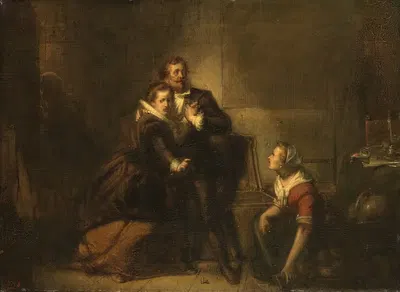
Mrs. Sharpe and Her Child (1731)
Joseph HighmoreFor your project
- Source and licence confirmed before use
- Print-ready master at your wall size
- Adapted to your format and palette on request
Provenance / Rights
- Rights
- Public domain (artist died 1780)
SPECIFICATIONS
- Artist
- Joseph Highmore
- Category
- Figurative
- Year
- 1731
- Nationality / school
- English
- Lifespan
- 1692–1780
- Orientation
- Portrait
- Material
- Digital JPEG + PDF files
- Available sizes
- Print-ready master at your wall size, on request
ABOUT THE ARTWORK
"Mrs. Sharpe and Her Child" (1731) is a work by Joseph Highmore. The catalogue places it in Figurative. The format is portrait. Figurative, a short history: Portraits, group scenes, studies of the nude, and pictures of daily life all belong to figurative art. Over the centuries, painters have used the figure to express social standing, narrative, and emotion. About the period around 1731: The Enlightenment and the habit of the Grand Tour fed a wider interest in science, travel, antiquity, and natural history, and illustrators accompanied many expeditions. The eighteenth century began with the light, ornamental Rococo, especially in France, and moved towards the clarity and antique references of Neoclassicism by the end of the century.
Buying "Mrs. Sharpe and Her Child" means getting a digital file, not a physical print: Digital JPEG + PDF files, 300 DPI, delivered by email once payment is confirmed. A 300 DPI file is intended for printing at home or at a local print shop, where you can choose a matte, satin, or fine-art paper to suit the room. A portrait format suits narrow wall spaces, hallways, and the area beside a door or window. Figurative works draw attention to the human presence, the gesture, and the emotional tone, so they work particularly well as a standalone focal point in living rooms, studies, and bedrooms. A simple frame with a mat often helps an image settle comfortably into a room. Hang the print away from direct sunlight, which over the years can fade any printed colour. Screens and printers render colour differently, so a small test print is a sensible way to check tones before committing to a large size. Matte and fine-art papers reduce glare in bright rooms, while glossy papers give stronger contrast and deeper blacks.
ABOUT THE ARTIST
English, 1692–1780
If you like the visual language of Joseph Highmore, explore more works by the same artist in our collection.