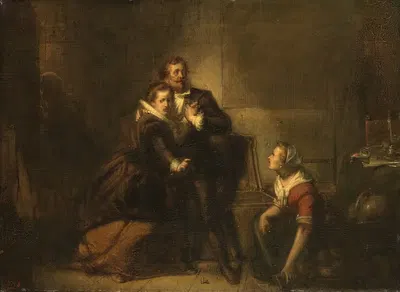
Hunter on a Horse-Drawn Cart (1912)
Jaroslav VěšínFor your project
- Source and licence confirmed before use
- Print-ready master at your wall size
- Adapted to your format and palette on request
Provenance / Rights
- Rights
- Public domain (artist died 1915)
SPECIFICATIONS
- Artist
- Jaroslav Věšín
- Category
- Figurative
- Year
- 1912
- Nationality / school
- Czech
- Lifespan
- 1860–1915
- Orientation
- Landscape
- Material
- Digital JPEG + PDF files
- Available sizes
- Print-ready master at your wall size, on request
ABOUT THE ARTWORK
Dated 1912, "Hunter on a Horse-Drawn Cart" is an artwork by Jaroslav Věšín. Figurative, a short history: Figurative art depicts people and recognisable scenes, and it has been central to European painting since antiquity. Portraits, group scenes, studies of the nude, and pictures of daily life all belong to figurative art. Historical background, 1912: The first decades of the twentieth century were a period of rapid experiment, with Fauvism, Expressionism, Cubism, Futurism, and the first abstract painting appearing within a few years of each other. Dada and Surrealism followed the First World War, the Bauhaus school was founded in 1919, and Art Deco became the fashionable decorative style of the 1920s and 1930s. The catalogue places it in Figurative. The format is landscape.
Buying "Hunter on a Horse-Drawn Cart" means getting a digital file, not a physical print: Digital JPEG + PDF files, 300 DPI, delivered by email once payment is confirmed. A 300 DPI file is intended for printing at home or at a local print shop, where you can choose a matte, satin, or fine-art paper to suit the room. A landscape format suits wide, low wall spaces such as the stretch above a bed, mantel, or sideboard. Figurative works draw attention to the human presence, the gesture, and the emotional tone, so they work particularly well as a standalone focal point in living rooms, studies, and bedrooms. A simple frame with a mat often helps an image settle comfortably into a room. Matte and fine-art papers reduce glare in bright rooms, while glossy papers give stronger contrast and deeper blacks. Choosing a standard frame size and printing to fit it often saves the cost of custom framing. Screens and printers render colour differently, so a small test print is a sensible way to check tones before committing to a large size.
ABOUT THE ARTIST
Czech, 1860–1915
If you like the visual language of Jaroslav Věšín, explore more works by the same artist in our collection.